
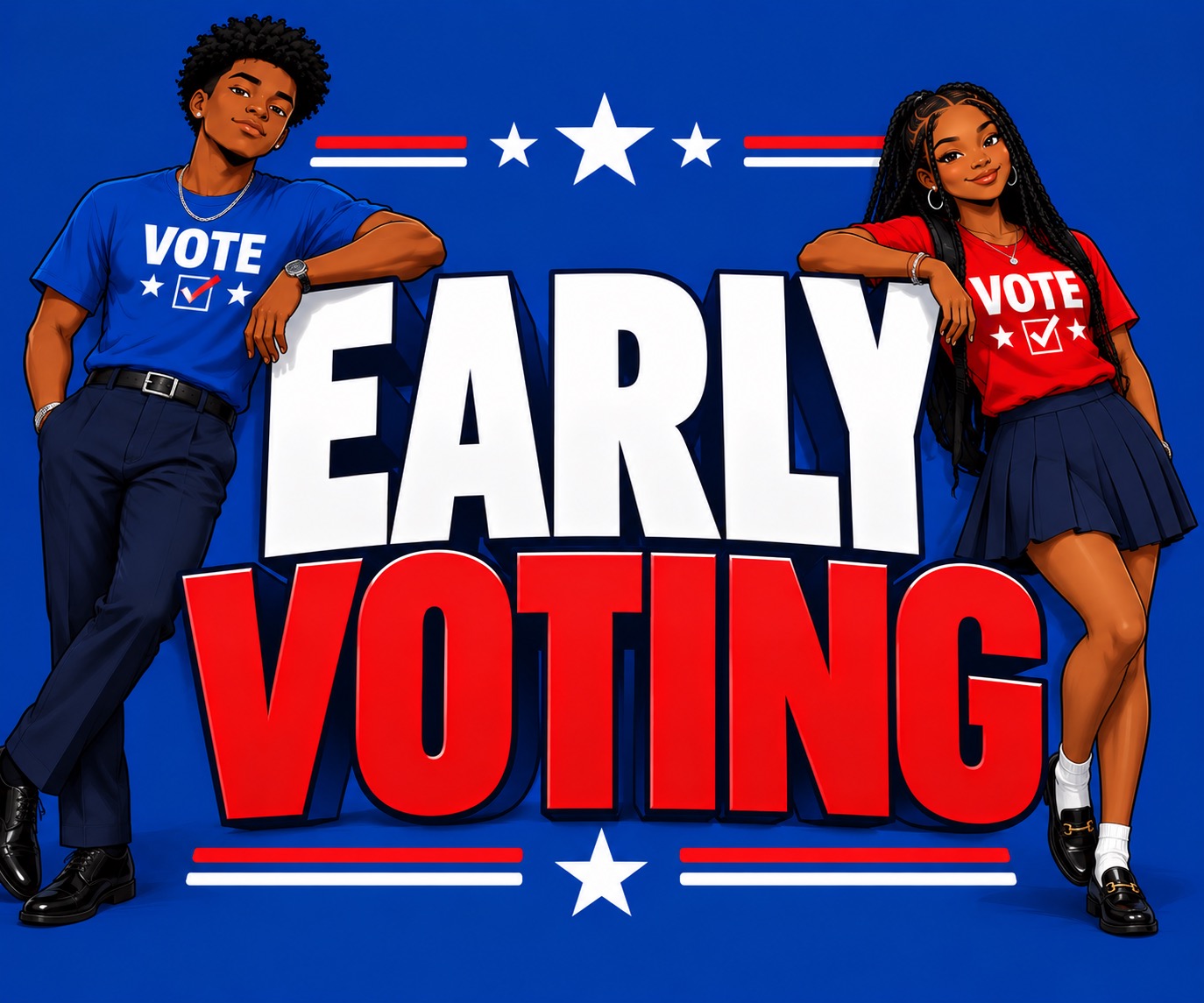
As early voting begins for the 2026 midterm elections, voting access has emerged as a major issue across the country, particularly for young voters and students at historically black colleges and universities(HBCUs).
For some young adults, voting may seem disconnected from their daily lives. However, access to the ballot box remains an important part of American democracy, especially for communities whose voting rights have historically been challenged.
In North Carolina, disputes over early voting locations and hours have amplified the debate over voter access. Republican-led election boards in some counties have moved to eliminate Sunday voting hours and campus polling sites, prompting criticism from Democrats and voting rights advocates who argue that these changes could create additional barriers for students and other voters.
At North Carolina Agricultural and Technical State University, the nation’s largest HBCU, students have repeatedly advocated for an on-campus early voting site. Their efforts reflect concerns about transportation barriers for students who do not own cars or have easy access to off-campus polling locations.
According to Ncvoices.com, more than 100 North Carolina A&T students marched to the polls Oct. 15, the first day of early voting in the state, to call attention to election officials’ decisions not to restore on-campus voting locations.
The demonstration underscored a broader question: How can young voters fully participate in elections when access to polling places presents additional challenges?
HBCUs and the fight for equal access
The debate over voting access carries particular significance for HBCUs, institutions established to provide educational opportunities to Black Americans when predominantly white colleges and universities largely excluded them.
For reference A&T was founded in 1891, decades before the University of North Carolina at Chapel Hill admitted its first Black students.
In 1951, Harvey Beech, James Lassiter, J. Kenneth Lee, Floyd McKissick and James Robert Walker enrolled in UNC’s School of Law after a court order required the university to admit Black students to the program. Their enrollment marked a significant moment in North Carolina’s struggle to desegregate higher education.
Three years later, the U.S. Supreme Court unanimously ruled in Brown v. Board of Education that state-mandated racial segregation in public schools violated the Equal Protection Clause of the 14th Amendment. The 1954 decision overturned the legal foundation of the “separate but equal” doctrine established by Plessy v. Ferguson in 1896 and became a turning point in the modern civil rights movement.
More than seven decades later, debates over access and equal participation continue to shape American public life. While voting restrictions differ from the barriers black students face in higher education, both issues raise questions about who has meaningful access to the institutions and processes that shape the country.
Young voters are making their voices heard
Despite concerns about access, young Americans are showing signs of increased interest in participating in elections.
The Civics Center, a nonprofit organization focused on youth voter registration, estimated that 42% of 18-year-olds nationwide were registered for the November 2026 midterm elections. That figure represents an increase from the summer of 2022, when an estimated 35% of 18-year-olds were registered ahead of that year’s midterm elections.
For students at North Carolina A&T and other HBCUs, the fight for accessible polling locations is about more than convenience. It is also about ensuring that young people can exercise their right to vote and participate in decisions affecting their education, communities and futures.
As the midterm elections approach, student-led efforts to expand voting access demonstrate that young voters are prepared to make their voices heard. Even when they must first overcome barriers to reaching the ballot box.